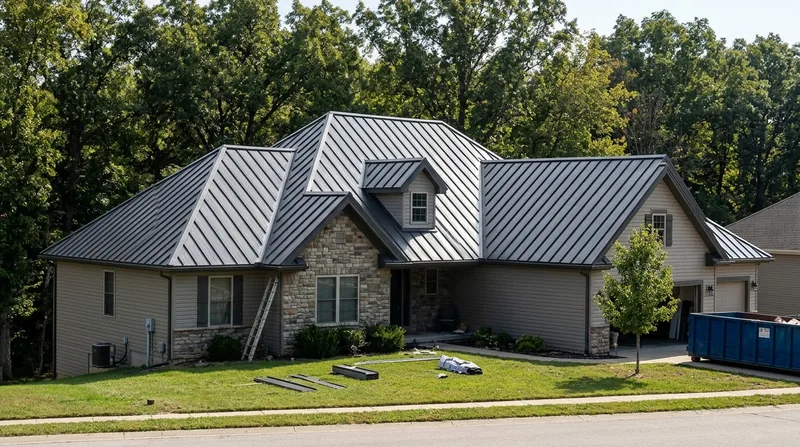




Columbia sits on rolling glacial-till hills at about 750 feet, where clay and limestone soil, white oaks, hickories and sugar maples frame neighborhoods from Benton-Stephens to Rock Bridge. On the 1890s to 1920s Victorians, Foursquares and Craftsman homes near downtown, steep roofs and brick chimneys take a beating from spring supercells, summer humidity and winter ice storms. Standing Seam Metal Roofing in Columbia gives those homes a concealed-fastener roof that expands and contracts with Missouri's daily temperature swings without backing out a single screw. We roll-form panels to length, seam them tight and detail the flashing so the roof sheds hail, wind-driven rain and ice the way it should. If you are still weighing options, start with our metal roof installation overview, then come back to standing seam for the premium path.
Why Standing Seam Metal Roofing Matters on Columbia's Hills and Historic Blocks
Boone County's building stock puts standing seam in a sweet spot. The 1950s to 1970s brick ranches and split-levels in Grasslands, Lenoir and Brown Station carry low-pitched shingle roofs that shed granules and grow algae in our humid summers. The 1990s to 2020s two-story vinyl, brick and stone homes across Cherry Hill, Rock Bridge and Stephens Lake face hail that dents and bruises architectural shingles. Standing seam answers both: no exposed fasteners to loosen, a reflective finish that cuts attic heat, and wind resistance that holds through straight-line gusts.
- Concealed clips let panels move with temperature instead of fighting it, which is the main reason screw-backed panels fail here.
- Mechanically seamed panels lock together and resist wind uplift far better than shingle tabs in a supercell.
- The smooth surface sheds snow and ice instead of letting it dam at the eaves during a February freeze-thaw cycle.
- Panels roll-formed to the exact roof length eliminate end laps, the seam that leaks first on older metal roofs.
- A reflective finish keeps the upstairs cooler through July and August humidity.
For historic homes in the Old Southwest and North Central districts, panel profile and color need to clear design review before we order steel. The City of Columbia's building permit portal is the place to confirm what your address requires: City of Columbia official site.
Key info: On a 1920s Foursquare in Benton-Stephens, we matched a standing seam profile to the original porch roofline and passed historic review before a single panel was formed. Skipping that step means tearing off new steel.
How We Install Standing Seam on a Columbia Roof
Every standing seam job starts with the deck, not the steel. We strip the old shingles, inspect the sheathing and repair soft spots around chimneys and skylights, then lay underlayment rated for our freeze-thaw winters. Panels are roll-formed on site to the exact length of each run, lifted without dragging across the ridge, and seamed with a mechanical seamer that closes the lock uniformly from eave to ridge.
- We measure every plane and slope, including dormers and the deep porch roofs common on Old Southwest homes.
- We remove the existing roof and replace any rotten decking before underlayment goes down.
- We set eave trim, valley metal and chimney flashing in coordination with our flashing and chimney repair crew.
- We roll-form panels to length on site and fasten them with concealed clips sized for the panel's thermal movement.
- We mechanically seam each rib, install ridge caps and penetrations, and pressure-test the details with a hose before cleanup.
On a recent Rocheport farmhouse, panels were formed in the driveway because the lane was too narrow for a delivery truck, which is the kind of logistics we plan for before the crew arrives.
Key info: A Hallsville machine shed with a 4/12 pitch got 26-gauge panels with a heavier clip pattern after we reviewed wind exposure on the open farmland. The same review applies to homes on the ridge lines above the Missouri River valley.
Standing Seam Approaches We Use
| Approach | Description | Best for |
|---|---|---|
| Mechanically seamed | Panels joined with a powered seamer for a continuous, watertight lock along every rib. | Primary homes on exposed ridges and open lots where wind uplift is the concern. |
| Snap-lock | Panels snap together over concealed clips without a mechanical seamer. | Porch roofs, garages and lower-slope sections where wind exposure is moderate. |
| 26-gauge steel | Heavier steel that resists hail dents and foot traffic better than 29-gauge. | Homes in hail-prone stretches of Boone County and long panel runs. |
| 24-gauge steel | The heaviest common residential panel, with the best impact and wind performance. | Historic homes and owners who want the longest service life. |
| Kynar 500 finish | Factory-applied finish that holds color through UV and humidity. | Any home where fading or chalky panels would be an eyesore. |
Standing Seam Metal Roofing Cost in Columbia: What to Expect
Standing seam is the highest-value roof we install, and the price reflects the steel, the roll-forming and the labor in the seams and flashing. Expect a starting point around $10 per square foot for the panels and basic installation, with most Columbia homes landing above that once tear-off, deck repair, underlayment and complex flashing are counted. The full pricing overview breaks down the variables in detail.
- Roof size and pitch drive the panel count and the number of seams the crew has to close.
- Access matters on steep historic blocks where a dumpster cannot sit close to the house.
- Chimneys, skylights and dormers add flashing labor that a plain gable roof never needs.
- Gauge and finish (26 vs 24-gauge, standard vs premium color) move the material cost.
- Tear-off of one or more shingle layers adds disposal and deck inspection time.
Getting two or three estimates is smart because standing seam bids vary widely in what they include. Ask each contractor whether tear-off, deck repair, underlayment and flashing are in the number or billed later.
What to Look For in a Standing Seam Metal Roofing Contractor Near Me in Columbia
Standing seam is less forgiving than shingle work, so the contractor matters as much as the panel. Ask for proof of licensing and insurance, and confirm the policy covers roofing, not just general liability. Get at least three written estimates that itemize tear-off, deck repair, underlayment, panel gauge, finish and flashing. Then ask for references from Columbia homeowners with the same roof style, and call them.
Permits are commonly required for a full replacement, and thresholds vary by jurisdiction, so confirm with the local building department before work starts. Historic districts like the Old Southwest and North Central can restrict panel profile and color, and HOAs across Cherry Hill and Rock Bridge often have their own design rules. Check both before you sign. When you are ready to talk through your roof, contact us for a free estimate.
Standing Seam Metal Roofing in Columbia: Pricing Guide
| Service | Price | Details |
|---|---|---|
| Standing seam installation | Starting at $10/sq ft | Panels, concealed clips and standard trim; pitch and roof complexity move the rate up. |
| Tear-off and redeck | Quoted per square | Removal of existing shingles and deck repair; number of layers and rot drive the price. |
| Complex flashing package | On estimate | Chimneys, skylights and valleys priced after an on-site look at the details. |
| Historic or HOA design review | Included | We help prepare profile and color details for review at no separate charge. |
| Travel | Included | in Columbia and surrounding areas, no separate call-out or mileage fee |
| Estimate | Free | Response within 24h at (573) 296-4898, no obligation to book |
Indicative pricing, the exact cost depends on square footage, finish, and site access. Free personalized estimate within 24h at (573) 296-4898.


